


A single question determines how much insurance coverage is available after a rideshare crash: What was the driver doing on the app at the exact moment the collision occurred?
Not before. Not after. At the moment of impact.
Uber and Lyft structure their insurance obligations around three distinct operational phases. Each phase triggers a different coverage tier, and the difference between them can mean the gap between $50,000 in available coverage and $1 million.
Rideshare companies do not volunteer which tier applies. Their claims teams are trained to handle these calls, and injured people making first contact without legal representation are at a structural disadvantage from that first conversation.
Our Englewood rideshare accident lawyers at Legal Help in Colorado handle Uber and Lyft accident claims throughout Arapahoe County. We determine coverage, identify every party with liability exposure, and go to trial when the numbers on offer don’t reflect what the injuries are actually worth. Call (303) 351-2567 for a free case review. No fees unless we win. Available 24/7.
How the Three Coverage Phases Work and Why They Matter
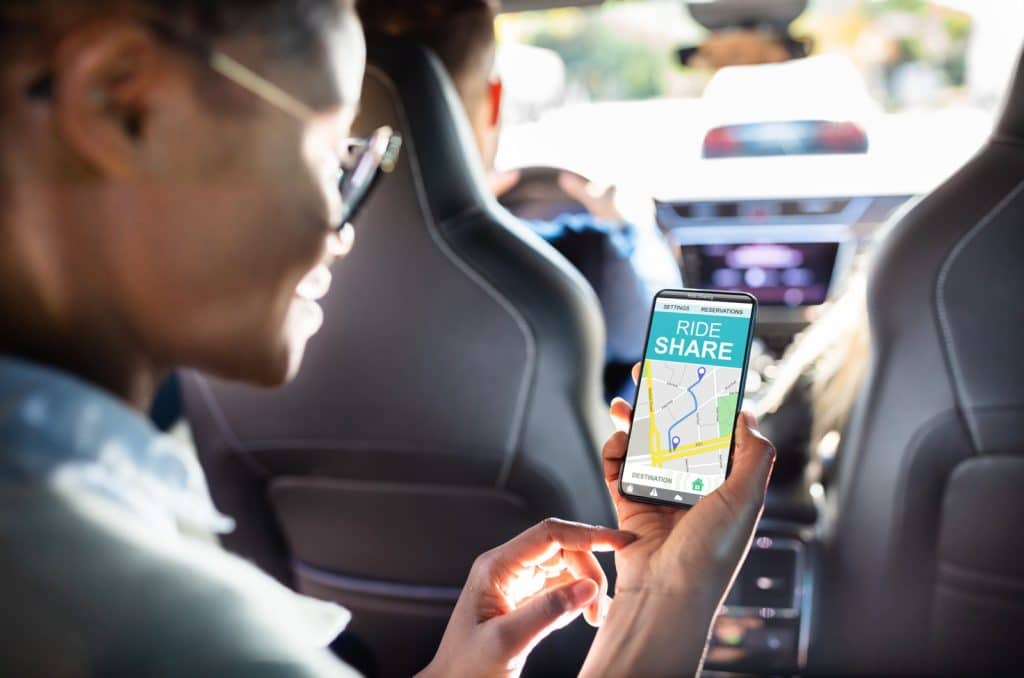
Understanding the coverage structure is the foundational step in any rideshare accident claim. The phase the driver was in when the crash happened shapes everything that follows.
Phase 1: App Off
The driver was not logged into Uber or Lyft at the time of the crash. In this scenario, neither company provides any coverage. The driver’s personal auto insurance is the only applicable policy.
Standard personal auto policies in Colorado must meet the state’s minimum liability requirements of $25,000 per person, $50,000 per accident, and $15,000 for property damage, though many drivers carry higher limits. If the driver carries only minimum coverage and your injuries are serious, underinsured motorist coverage through your own policy becomes the primary avenue for full recovery.
Phase 2: App On, No Accepted Ride
The driver was logged in and available but had not yet accepted a trip. Uber and Lyft each provide contingent liability coverage in this phase: $50,000 per person, $100,000 per accident, and $25,000 for property damage.
This coverage only applies if the driver’s personal insurance denies the claim or is insufficient. The contingent structure creates a dispute dynamic where the personal insurer and the rideshare company each have a financial incentive to argue that the other is primarily responsible.
Phase 3: Ride Accepted Or Passenger In Vehicle
The driver accepted a trip, was en route to pick up a passenger, or was actively transporting a passenger. Both Uber and Lyft provide $1 million in third-party liability coverage in this phase, plus uninsured/underinsured motorist coverage and contingent comprehensive and collision coverage. This is the highest coverage tier and also the phase that rideshare companies scrutinize most closely when processing claims.
Determining which phase applied requires obtaining the driver’s trip log from the platform, which neither Uber nor Lyft releases voluntarily. We request this documentation through formal legal channels and cross-reference it with crash timing data, witness accounts, and any available surveillance footage to establish the precise operational phase at impact.
Call (303) 351-2567 to speak with an Englewood rideshare accident attorney. Free case review, no fees unless we recover for you.
Awards & Accolades
The “Dual-App” Coverage Dilemma
Many rideshare drivers keep both the Uber and Lyft apps open simultaneously to minimize downtime between passengers. If a driver causes a crash while actively looking for fares on both platforms, a complex multi-company dispute arises. Both corporate insurers will instinctively point fingers at the other to deny primary liability under Colorado’s rideshare insurance requirements.
Our legal team cuts through this strategic gridlock by subpoenaing the digital timestamps from both platforms. We pinpoint exactly which app registered a network handshake or ping in the seconds leading up to the impact to force the correct carrier to accept the claim.
Where Rideshare Accidents Concentrate in Englewood
Englewood’s rideshare activity patterns are shaped by the Englewood light rail station, the Swedish Medical Center corridor, and the South Broadway commercial and entertainment strip. Each environment generates specific crash risk profiles.
- The Englewood Station and CityCenter Englewood: The light rail station on Englewood Parkway near the CityCenter development is one of the highest-density rideshare pickup and dropoff points in the city. Drivers waiting for or completing ride requests in this area frequently stop in travel lanes, move through parking structures without adequate awareness of pedestrians, or accelerate into moving traffic from a stopped position as a new ride request comes in.
The distracted driving hazard specific to rideshare drivers, checking the app for ride assignments, is particularly acute at transit hubs where multiple drivers compete for incoming passengers.
- South Broadway between Hampden Avenue (US-285) and Quincy Avenue: The restaurant and retail corridor along South Broadway generates consistent evening and weekend rideshare demand. Drivers navigating narrow commercial parking lots, making sudden stops at entrances, or double-parking while waiting for passengers create conflicts with cyclists, pedestrians, and other vehicles.
Crashes in this environment often involve a driver whose attention was divided between the road and the app notification that a passenger was ready.
Who Can Be Liable in a Rideshare Crash
Rideshare accidents routinely involve more than one party with potential liability. Identifying all of them is critical to recovering full value for serious injuries.
The rideshare driver. Driver negligence, whether from distracted driving, speeding, running signals, or fatigued driving from working multiple jobs, is the most direct liability theory. Rideshare drivers are classified as independent contractors under both Uber’s and Lyft’s operational agreements, which affects but does not eliminate the companies’ liability exposure.
Uber or Lyft directly. The independent contractor classification creates a legal barrier to vicarious liability in most circumstances. However, direct negligence claims against the companies are available when the evidence shows inadequate screening of drivers, failure to respond to prior safety complaints, or negligent design of the app interface in ways that increase driver distraction.
These claims require a different evidentiary approach than driver negligence claims and are worth evaluating in serious injury cases.
A third-party driver. Many rideshare crashes involve a collision between the rideshare vehicle and another driver who was at fault. In these cases, the third-party driver’s liability policy is the primary coverage source, with the rideshare company’s policy providing supplemental coverage depending on the phase and the nature of the injury.
Property owners near pickup and dropoff zones. Where a crash occurs in or adjacent to a parking structure, commercial driveway, or transit hub access point, the property owner’s maintenance and design of that space may bear on liability, particularly if inadequate lighting, missing signage, or obstructed sight lines contributed to the collision.
Multiple insurers, one set of injuries. We find every policy in play. Call (303) 351-2567 for a free case review, available 24/7.
Preserving Digital Telematics and App Data
In a standard car accident, fault relies heavily on physical skid marks and witness statements. In a rideshare crash, the most critical evidence is digital. Uber and Lyft platforms constantly track granular telematics data, including precise GPS locations, vehicle speed, braking intensity, and even screen-touch intervals. This evidence can be crucial in determining who is liable in a ridesharing car accident.
If an attorney does not immediately send a formal spoliation letter (a legal demand to preserve evidence), this data can be automatically purged by the tech platforms. We secure this electronic data early to prove exactly how fast the driver was moving and whether they were actively distracted by a screen notification at impact, helping establish the consequences of distracted driving in Colorado.
At the Englewood Station and South Broadway pickup zones specifically, we have found that the gap between what a rideshare company reports as the driver’s app status and what the GPS telematics actually show is one of the most consequential disputes in these claims. We send spoliation letters to both Uber and Lyft within the first days of retention on Englewood cases, before platform data purge cycles run.
When the telematics contradict the company’s initial phase classification, that evidence can move a claim from $50,000 in contingent coverage to $1 million in Phase 3 coverage. Getting those records before they are gone is one of the most time-sensitive things we do on any rideshare case.
The data disappears on the platform’s schedule, not yours. Call (303) 351-2567 now so we can preserve it.
Injured in a car accident?
Contact Our Englewood Rideshare Accident Attorneys Today
What Injured Passengers Often Get Wrong About Their Claims
Passengers injured in a rideshare accident frequently make two assumptions that cost them.
The first assumption is that being a passenger automatically protects their claim. It does help with fault, since passengers are rarely assigned comparative negligence. But it does not simplify the insurance question.
A passenger injured when their Uber driver caused a crash still needs to determine whether Phase 3 coverage applies, whether the driver’s personal policy provides any supplemental coverage, and whether their own MedPay or health insurance should be used strategically to cover immediate treatment costs while the liability claim develops.
The second assumption is that Uber and Lyft’s $1 million coverage tier is readily available. In practice, these companies investigate claims aggressively before acknowledging Phase 3 status.
App records get reviewed in detail. If there is any ambiguity about whether the trip was active at the moment of impact, the coverage determination becomes contested. We obtain the trip log documentation, the GPS data from the driver’s device, and the platform’s internal records to establish Phase 3 status factually rather than relying on the company’s self-reporting.
Our attorneys have recovered a $10.5 million verdict and a $2 million settlement for injured clients across Colorado. Results may vary. Prior case outcomes do not guarantee similar results. We bring that same preparation to rideshare cases, where the layered insurance structure demands careful and thorough legal work from the outset. If you need an experienced Englewood personal injury attorney, our team is prepared to protect your rights and pursue the compensation you deserve.
Meet Our Englewood Auto Accident Lawyers
Frequently Asked Questions
I was a passenger in an Uber that got hit by another driver. Who do I claim against?
Both parties may have liability exposure, so you often claim against more than one. The third-party driver who caused the crash is the primary defendant. Uber’s Phase 3 coverage provides supplemental protection if that driver’s policy is insufficient, and Uber’s uninsured/underinsured motorist coverage can bridge the gap to your actual damages. We analyze both policies at the outset of every passenger case.
What if Uber or Lyft says the driver was offline when the crash happened?
Do not take that at face value. The company controls the data behind its own classification, and its first account is not always definitive. We pull the trip records, GPS data, and crash timing to check whether the driver was actually offline at impact. When that evidence contradicts the company, it can move your claim into a far higher coverage tier.
Can I make a claim against Lyft if their driver was at fault, but I wasn’t in the car?
Yes. If a Lyft driver struck your vehicle or hit you as a pedestrian, you can make a third-party claim against the applicable coverage tier, even though you were never a passenger. The driver’s app status at the moment of the crash determines which tier of coverage applies to your injuries.
Does my own auto insurance matter if I was injured in a rideshare crash?
Potentially, yes. MedPay coverage on your own policy may help pay medical expenses regardless of fault. UM/UIM coverage may also apply if the at-fault driver lacks sufficient insurance. In Colorado, these benefits can sometimes apply even if you were walking or riding a bicycle when the crash occurred. Reviewing all available policies is important, along with maintaining medical records after an accident to support your claim and coverage review.
How long do I have to file a rideshare accident claim in Colorado?
Motor-vehicle crash claims carry a three-year statute of limitations under C.R.S. Section 13-80-101. Wrongful-death deadlines can differ, so we confirm the exact deadline for your situation early. Acting promptly matters either way: Uber and Lyft preserve trip data on their own schedules, and obtaining complete records before litigation requires moving quickly.
What if the rideshare driver had a prior history of unsafe driving?
Potentially. If evidence shows a rideshare company knew or should have known a driver posed a safety risk but allowed them to continue driving, a negligent hiring or retention claim may be possible. Investigating prior violations, crashes, or safety complaints often requires obtaining records through the legal discovery process.
Talk to an Englewood Rideshare Accident Lawyer Today
Rideshare claims are not standard car accident cases. The insurance structure is layered, the corporate defendants are sophisticated, and the coverage determination is contested from the start. Our attorneys understand how these claims work, how the companies handle them, and what it takes to recover full value for serious injuries.

Call (303) 351-2567 or (303) 529-3333 for a free case review. No fees unless we win. Available 24/7.
Legal Help in Colorado | 8480 E Orchard Rd, Suite 2400, Greenwood Village, CO 80111 | Real Lawyers for Real People