


Colorado does not require motorcycle riders over 18 to wear a helmet. That legal fact matters less than riders expect when an insurance adjuster gets involved.
Carriers routinely build their damage reduction strategy around gear choices, positioning a helmetless rider as someone who assumed the risk of their own injuries regardless of who caused the crash. The legal question worth understanding is not whether you wore a helmet. It is whether your gear choices actually caused or worsened the specific injuries you sustained, and whether that evidence belongs in front of a jury at all.
Key Takeaways: The No-Helmet Defense
- Colorado motorcycle helmet laws do not require riders over 18 to wear a helmet, making non-use legal under C.R.S. § 42-4-1502.
- Insurers and defense attorneys regularly attempt to use helmet non-use to reduce damage awards by arguing the rider contributed to their own injuries.
- Colorado’s modified comparative negligence rule bars recovery only when the plaintiff is 50 percent or more at fault, but any assigned percentage of fault reduces the damages award proportionally.
- Courts may exclude evidence of gear choices when those choices had no causal relationship to the specific injuries sustained in the collision.
- Biker bias operates both in insurance negotiations and in jury selection, making case framing and evidence strategy critical from the first demand letter forward.
What Colorado Motorcycle Helmet Laws Actually Say
Colorado’s helmet statute is direct. Riders 18 and older have no legal obligation to wear a helmet under state law. Riders under 18 must wear protective headgear meeting applicable safety standards. The law does not impose a gear requirement for jackets, gloves, or protective footwear at any age. A rider who chooses to operate a motorcycle without a helmet on a Colorado road commits no traffic violation under helmet laws in Colorado for motorcyclists.
Does legal helmet non-use still affect a personal injury claim?
Yes, and this is where the gap between traffic law and tort law creates problems for injured riders. Legal conduct under a traffic statute does not automatically shield that conduct from scrutiny in a civil negligence case.
Defense attorneys argue that a reasonable person, regardless of what the statute requires, would have worn a helmet, and that the failure to do so contributed to the rider’s injuries. Whether that argument succeeds depends entirely on whether the injuries at issue are ones a helmet would have prevented or reduced.
What protective gear does Colorado law require?
Beyond the under-18 helmet requirement, Colorado law mandates that motorcycles be equipped with eye protection or a windshield, but it does not require riders to wear eye protection themselves if the motorcycle has a windshield. These requirements are part of Colorado’s motorcycle laws governing rider safety and equipment.
No other personal protective equipment is legally mandated for riders. In practice, this means that a rider involved in a Colorado crash without a jacket, gloves, or boots has violated no statute, yet insurers treat gear absences as evidence of recklessness in damages negotiations.
How Insurance Companies Use Biker Bias to Reduce Motorcycle Accident Damages
Biker bias is not a legal doctrine. It is a documented pattern of behavior by insurers and, in some cases, jurors who assign greater fault to motorcycle riders than the evidence supports. Understanding how that bias operates is the first step toward neutralizing it.
How does biker bias appear in insurance negotiations?
It surfaces early. An adjuster handling a motorcycle accident claim in Colorado will often request photographs of the rider at the scene, ask about gear choices in recorded statements, and reference non-use in initial demand responses even when the claimed injuries have no connection to the head or face.
The goal is to introduce comparative fault into the damages calculation before litigation begins. A rider who accepts a settlement built on an inflated fault percentage loses compensation they were legally entitled to recover.
Does biker bias affect jury behavior in Colorado motorcycle trials?
Research on juror attitudes consistently shows that motorcyclists face greater skepticism than passenger vehicle occupants when both parties describe the same accident from opposing perspectives. Specifically, jurors who hold preexisting views about motorcycle riders as risk-takers may assign higher comparative fault percentages than the evidence justifies.
This is not a theoretical concern in Denver metro courtrooms. It is a practical reality that shapes how we frame every aspect of a motorcycle accident case, from the language in demand letters to the voir dire questions we use during jury selection. An experienced Colorado motorcycle accident lawyer understands how to address these issues from the outset to build the strongest possible case.
What is the relationship between comparative negligence and motorcycle accident damages in Colorado?
Colorado follows a modified comparative negligence standard. A rider who a jury finds to be less than 50 percent at fault for their own injuries recovers damages reduced by their percentage of fault.
A rider found to be 50 percent or more at fault recovers nothing. In a case where the at-fault driver clearly caused the collision, defense counsel may still pursue a comparative fault reduction by emphasizing gear choices, speed, lane position, or any other rider behavior, even behavior that had no causal relationship to the crash itself.
The Non-Use Exclusion: Keeping Gear Choices Out of Evidence
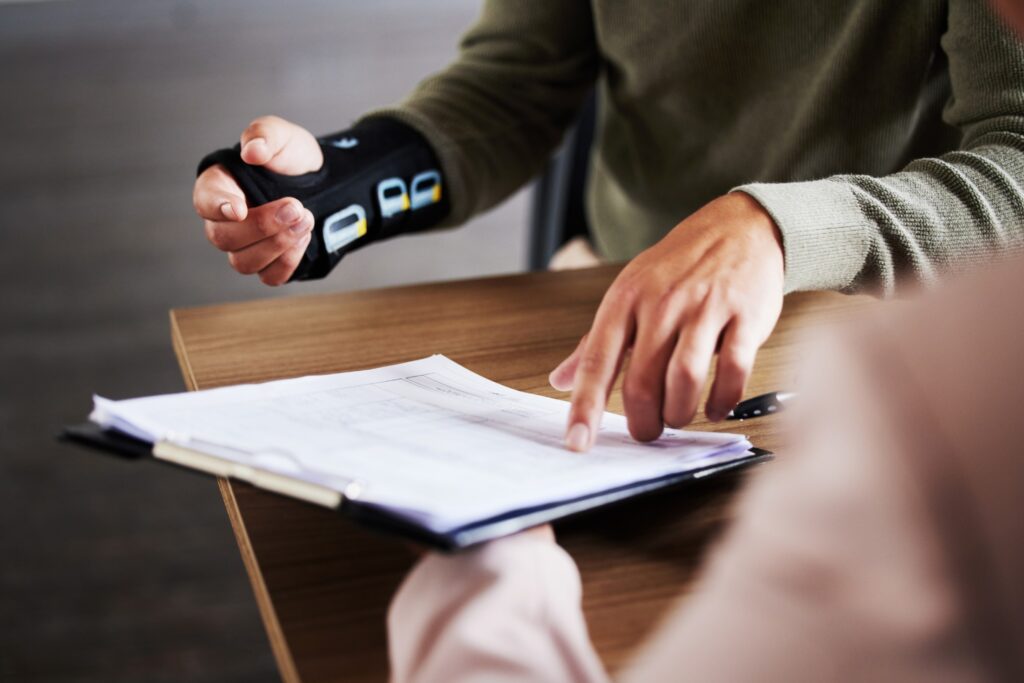
The most effective tool against the no-helmet defense is an evidentiary argument, not just a factual one. When a rider’s injuries have no causal connection to helmet non-use, evidence of that non-use may be excludable under Colorado’s rules of evidence as irrelevant and unfairly prejudicial.
What is the legal standard for excluding helmet non-use evidence?
Colorado Rule of Evidence 401 defines relevant evidence as evidence that makes a fact of consequence more or less probable. Colorado Rule of Evidence 403 permits exclusion of relevant evidence when its probative value is substantially outweighed by the danger of unfair prejudice.
When a rider sustains leg fractures, road rash, or other non-head injuries from a collision, evidence that they were not wearing a helmet carries minimal probative value on those specific injuries while carrying significant prejudicial weight.
How do we establish that helmet non-use did not contribute to the injuries?
The primary method is specialist testimony from a biomechanical engineer or accident reconstruction specialist who analyzes the mechanics of the collision and the injury causation sequence.
Specifically, the specialist reviews the crash dynamics, the point of impact, the rider’s trajectory, and the medical records documenting the injuries sustained. When the analysis shows that a helmet would not have prevented or reduced the claimed injuries because the head was not the primary impact zone or because the forces involved exceeded any helmet’s protective capacity, the non-use exclusion argument becomes significantly stronger.
Does the same exclusion argument apply to other gear choices?
Yes. When an insurer argues that a rider’s road rash was worsened by the absence of protective gear, the same causal analysis applies. Road rash is a real and often serious injury category, but the absence of protective clothing does not transfer fault for the collision itself to the rider. The at-fault driver’s negligence produced the crash.
The rider’s gear choices affected the injury outcome only in a downstream sense, and courts have the authority to limit how that downstream causation gets used against an injured plaintiff.
On Colorado motorcycle claims where helmet non-use is raised early in the adjuster’s demand response, our first move is commissioning a biomechanical review of the injury causation sequence before responding to the carrier. That review establishes whether the head was a primary impact zone and whether a helmet would have altered the injury outcome, which is the threshold question for any exclusion argument under Colorado Rules of Evidence 401 and 403.
In Denver metro cases, insurers raise helmet non-use most aggressively when policy limits are high and liability is clear. When the biomechanical record shows no causal relationship between helmet non-use and the claimed injuries, we move to exclude that evidence before the case reaches a jury, because the prejudicial weight of gear choices in front of a Colorado jury is significant enough that exclusion is often more valuable than countering it at trial.
Building the Case Around the Driver’s Negligence
When biker bias operates through comparative fault arguments, the counter-strategy is ensuring that the at-fault driver’s conduct stays in the foreground of every stage of the case. A jury or adjuster focused on the driver’s behavior has less cognitive space to assign fault based on the rider’s gear.
What evidence best establishes driver negligence in a Colorado motorcycle crash?
Strong cases typically rely on multiple independent sources of evidence. This can include traffic camera footage, witness statements, cell phone records, and the police report.
Together, these materials help establish what happened before the crash and can make it harder for insurers to dispute motorcycle accident liability or minimize fault.
How does accident reconstruction support a Colorado motorcycle injury claim?
An accident reconstruction specialist uses physical evidence from the scene, vehicle damage patterns, skid marks, road geometry, and witness accounts to establish a timeline of the crash sequence.
In motorcycle cases, that reconstruction often demonstrates that the rider had no reasonable opportunity to avoid the collision regardless of speed or lane position. Specifically, when the reconstruction confirms that the at-fault driver created the hazard faster than a rider could perceive and respond, contributory fault arguments based on rider behavior lose credibility with both adjusters and juries.
Ask Legal Help in Colorado
If I weren’t wearing a helmet during my motorcycle crash in Colorado, can I still sue the driver who hit me?
Yes. Colorado law does not require riders over 18 to wear a helmet, and not wearing one does not prevent you from bringing a personal injury claim. However, helmet non-use may be considered under comparative negligence if it is relevant to the injuries sustained. Its impact depends on whether a helmet would have actually prevented or reduced those specific injuries.
The insurance adjuster asked me in a recorded statement whether I was wearing gear. Did that hurt my case?
Recorded statements given without legal representation can create issues in motorcycle injury cases because insurers may use them to argue for reduced damages. However, what is said in those statements is not the final word on liability or compensation. The impact depends on the injuries involved and whether gear use is actually relevant to those injuries. It is advisable to get legal guidance before providing further statements.
Can road rash injuries support a significant damage claim in Colorado?
Yes. Road rash is a recognized injury category that can support a substantial claim, especially when treatment is extended or the effects are lasting. In Colorado, your compensation can include medical costs, lost income, the cost of future treatment, and non-economic damages such as pain and disfigurement. Insurers routinely undervalue these claims, which is exactly why documenting the full cost matters.
Colorado Motorcycle Helmet and Gear Questions Answered by Our Greenwood Village Attorneys
Does wearing no helmet affect the value of a Colorado motorcycle settlement if my head was not injured?
When the head and face are not injured in a crash, helmet non-use is generally not relevant to the damage analysis. It should not reduce compensation if it did not contribute to the injuries. Insurers may still raise it during negotiations, but its impact can be challenged by showing medical evidence that the injuries were unrelated to head protection.
Can a Colorado jury hear about my gear choices even if my attorney objects?
A judge decides evidentiary objections based on the facts and legal arguments presented. In some cases, evidence about gear use may be admitted with limits if it is deemed relevant to injury causation. If exclusion is not possible, its impact can still be reduced through specialist testimony and an effective trial strategy.
How does biker bias affect jury selection in Colorado motorcycle trials?
During jury selection, attorneys may ask jurors about their views on motorcycle riders, their experience with motorcycles, and any assumptions about rider risk. Jurors who believe riders automatically assume all danger may be challenged or removed if permitted. Careful jury selection helps ensure a fair evaluation of the evidence in a motorcycle accident case, and experienced Colorado personal injury lawyers understand how to identify and address potential juror bias.
Ride Type Doesn’t Determine Fault

A driver who failed to check mirrors before changing lanes, ran a red light on Colorado Boulevard, or pulled across traffic on US-36 caused a crash. That conduct does not become less negligent because the person they hit was on a motorcycle. What you wore that day is a separate question, and in many cases, it is a question that does not belong in the courtroom at all.
We represent Colorado motorcycle riders in Denver, Greenwood Village, Centennial, Littleton, and across the state. We challenge comparative fault assignments, fight gear-based damage reductions, and take motorcycle accident cases to trial when insurers refuse to evaluate them on the actual evidence. No fees unless we recover for you.
Call us at (303) 529-3333 or (303) 351-2567 for a free consultation. Available 24/7.